 Add to Chrome
 Add to Firefox
 Add to Edge
OphIn-500K: Curating Web-Scale Visual Instructions for Scaling Ophthalmic Multimodal Large Language Models
May 27, 2026
The advancement of general medical Multimodal Large Language Models (MLLMs) has shown great potential for building conversational assistants to support clinical diagnosis. However, their adaptation to highly specialized domains such as ophthalmology remains underexplored, primarily due to the scarcity of large-scale, domain-specific instruction-tuning data. Existing ophthalmic datasets for conversational agents are often limited in scale and largely rely on images from established public benchmarks, limiting the scalability of ophthalmic MLLMs and their ability to capture real-world clinical complexity. To address this gap, we propose $\textbf{OphIn-Engine}$, an ophthalmology-specific instruction data curation pipeline that constructs high-quality instruction data from open-access ophthalmology web-scale videos. The pipeline integrates multimodal transcription for extracting image-transcript pairs, visual cue separation and scoring for identifying clinically relevant visual descriptions, and instruction synthesis with quality control for generating accurate and diverse clinical dialogues. Using this engine, we introduce $\textbf{OphIn-500K}$, a large-scale multimodal ophthalmology instruction-tuning dataset containing over 500,000 instruction instances and more than 151,000 unique images from over 29,000 video clips, formatted as visual question answering (VQA), multi-turn conversational interactions, and chain-of-thought (CoT) reasoning. Built upon this dataset, we further develop $\textbf{OphIn-VL}$, an ophthalmology-specific MLLM with advanced visual understanding and conversational capabilities. Comprehensive experiments and case studies demonstrate that OphIn-VL achieves superior performance compared with state-of-the-art general medical and domain-specific MLLMs.

Mags-RL: Wearing Multimodal LLMs a Magnifying Glass via Agentic Reinforcement Learning For Complex Scene Reasoning
May 27, 2026Despite their popularity and success, Multimodal Large Language Models (MLLMs) often struggle to interpret images accurately, which limits their reasoning capability in complex scenarios (e.g., high object density and complex background clutter). Prior work mainly addresses this limitation by incorporating explicit visual cues like bounding boxes that require extra annotations. In addition, the resulting low-resolution crops often miss fine-grained details that MLLMs require for accurate reasoning. Therefore, we propose Mags-RL, an Agentic Reinforcement Learning (RL) framework that equips MLLMs with an external super-resolution "magnifying glass" agent for high-resolution fine-grained inspection. Specifically, the model performs two-round reasoning: in the first round, it generates an initial rationale and autonomously identifies regions of interest without relying on additional annotations; in the second round, it invokes a super-resolution agent to crop and upscale those regions, then revisits and verifies its earlier reasoning to produce the final answer. We also introduce a novel curriculum learning strategy that enables data-efficient RL training, needing as few as only 40 training samples to achieve reasonable performance. Experiments on VSR, TallyQA, and GQA subsets show its superior performance against recent strong competing methods, demonstrating high-quality reasoning with precise visual grounding. Code and weights will be released soon.
Your Agent is More Brittle Than You Think: Uncovering Indirect Injection Vulnerabilities in Agentic LLMs
Apr 04, 2026The rapid deployment of open-source frameworks has significantly advanced the development of modern multi-agent systems. However, expanded action spaces, including uncontrolled privilege exposure and hidden inter-system interactions, pose severe security challenges. Specifically, Indirect Prompt Injections (IPI), which conceal malicious instructions within third-party content, can trigger unauthorized actions such as data exfiltration during normal operations. While current security evaluations predominantly rely on isolated single-turn benchmarks, the systemic vulnerabilities of these agents within complex dynamic environments remain critically underexplored. To bridge this gap, we systematically evaluate six defense strategies against four sophisticated IPI attack vectors across nine LLM backbones. Crucially, we conduct our evaluation entirely within dynamic multi-step tool-calling environments to capture the true attack surface of modern autonomous agents. Moving beyond binary success rates, our multidimensional analysis reveals a pronounced fragility. Advanced injections successfully bypass nearly all baseline defenses, and some surface-level mitigations even produce counterproductive side effects. Furthermore, while agents execute malicious instructions almost instantaneously, their internal states exhibit abnormally high decision entropy. Motivated by this latent hesitation, we investigate Representation Engineering (RepE) as a robust detection strategy. By extracting hidden states at the tool-input position, we revealed that the RepE-based circuit breaker successfully identifies and intercepts unauthorized actions before the agent commits to them, achieving high detection accuracy across diverse LLM backbones. This study exposes the limitations of current IPI defenses and provides a highly practical paradigm for building resilient multi-agent architectures.
Bridging Restoration and Diagnosis: A Comprehensive Benchmark for Retinal Fundus Enhancement
Apr 04, 2026Over the past decade, generative models have demonstrated success in enhancing fundus images. However, the evaluation of these models remains a challenge. A benchmark for fundus image enhancement is needed for three main reasons:(1) Conventional denoising metrics such as PSNR and SSIM fail to capture clinically relevant features, such as lesion preservation and vessel morphology consistency, limiting their applicability in real-world settings; (2) There is a lack of unified evaluation protocols that address both paired and unpaired enhancement methods, particularly those guided by clinical expertise; and (3) An evaluation framework should provide actionable insights to guide future advancements in clinically aligned enhancement models. To address these gaps, we introduce EyeBench-V2, a benchmark designed to bridge the gap between enhancement model performance and clinical utility. Our work offers three key contributions:(1) Multi-dimensional clinical-alignment through downstream evaluations: Beyond standard enhancement metrics, we assess performance across clinically meaningful tasks including vessel segmentation, diabetic retinopathy (DR) grading, generalization to unseen noise patterns, and lesion segmentation. (2) Expert-guided evaluation design: We curate a novel dataset enabling fair comparisons between paired and unpaired enhancement methods, accompanied by a structured manual assessment protocol by medical experts, which evaluates clinically critical aspects such as lesion structure alterations, background color shifts, and the introduction of artificial structures. (3) Actionable insights: Our benchmark provides a rigorous, task-oriented analysis of existing generative models, equipping clinical researchers with the evidence needed to make informed decisions, while also identifying limitations in current methods to inform the design of next-generation enhancement models.
OTPrune: Distribution-Aligned Visual Token Pruning via Optimal Transport
Feb 25, 2026Multi-modal large language models (MLLMs) achieve strong visual-language reasoning but suffer from high inference cost due to redundant visual tokens. Recent work explores visual token pruning to accelerate inference, while existing pruning methods overlook the underlying distributional structure of visual representations. We propose OTPrune, a training-free framework that formulates pruning as distribution alignment via optimal transport (OT). By minimizing the 2-Wasserstein distance between the full and pruned token distributions, OTPrune preserves both local diversity and global representativeness while reducing inference cost. Moreover, we derive a tractable submodular objective that enables efficient optimization, and theoretically prove its monotonicity and submodularity, providing a principled foundation for stable and efficient pruning. We further provide a comprehensive analysis that explains how distributional alignment contributes to stable and semantically faithful pruning. Comprehensive experiments on wider benchmarks demonstrate that OTPrune achieves superior performance-efficiency tradeoffs compared to state-of-the-art methods. The code is available at https://github.com/xiwenc1/OTPrune.
Bayesian Preference Learning for Test-Time Steerable Reward Models
Feb 09, 2026Reward models are central to aligning language models with human preferences via reinforcement learning (RL). As RL is increasingly applied to settings such as verifiable rewards and multi-objective alignment, RMs are expected to encode more complex and multifaceted preference distributions. However, classifier RMs remain static once trained, limiting their adaptability at test time. We propose Variational In-Context Reward Modeling (ICRM), a novel Bayesian reward modeling objective that enables test-time steerability via in-context preference demonstrations. ICRM casts reward modeling as amortized variational inference over a latent preference probability under the Bradley-Terry model using a conjugate Beta prior. We show that ICRM adapt to unseen preference distributions at test time for both single and multi-objective settings. With more in-context demonstrations, ICRM gains 34% accuracy on SafeRLHF and 9% accuracy on RM-Bench in the single-objective setting, while widening the Pareto frontier with a 4% gain in hypervolume on helpfulness and refusal benchmarks. We further study the practical applicability of ICRM for RL training, showing that it can effectively encode verifiable rewards by outperforming a conventional RM in math reasoning. Finally, we provide theoretical guarantees that the variational objective admits a global interior optimum with finite confidence, and we analyze how KL regularization mitigates reward over-optimization.
Distilling the Essence: Efficient Reasoning Distillation via Sequence Truncation
Dec 24, 2025Distilling the reasoning capabilities from a large language model (LLM) to a smaller student model often involves training on substantial amounts of reasoning data. However, distillation over lengthy sequences with prompt (P), chain-of-thought (CoT), and answer (A) segments makes the process computationally expensive. In this work, we investigate how the allocation of supervision across different segments (P, CoT, A) affects student performance. Our analysis shows that selective knowledge distillation over only the CoT tokens can be effective when the prompt and answer information is encompassed by it. Building on this insight, we establish a truncation protocol to quantify computation-quality tradeoffs as a function of sequence length. We observe that training on only the first $50\%$ of tokens of every training sequence can retain, on average, $\approx94\%$ of full-sequence performance on math benchmarks while reducing training time, memory usage, and FLOPs by about $50\%$ each. These findings suggest that reasoning distillation benefits from prioritizing early reasoning tokens and provides a simple lever for computation-quality tradeoffs. Codes are available at https://github.com/weiruichen01/distilling-the-essence.
Reasoning Models Can be Accurately Pruned Via Chain-of-Thought Reconstruction
Sep 15, 2025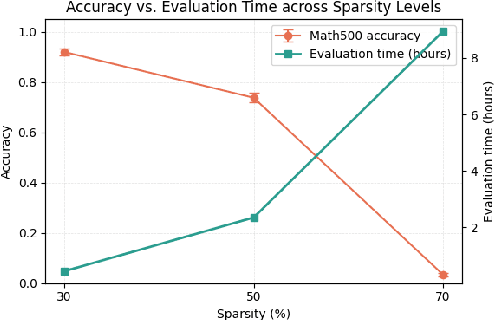
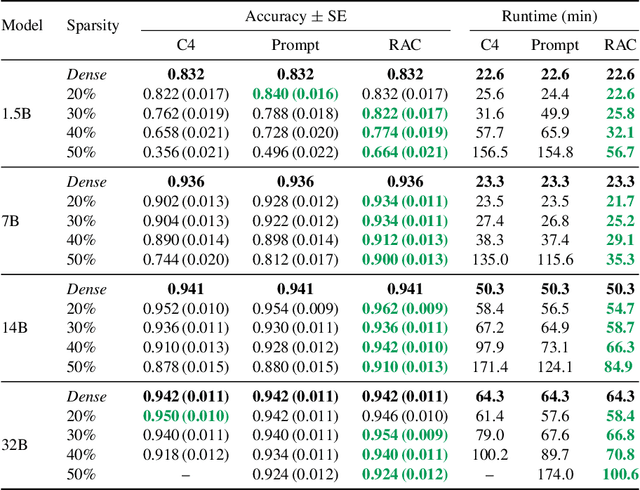

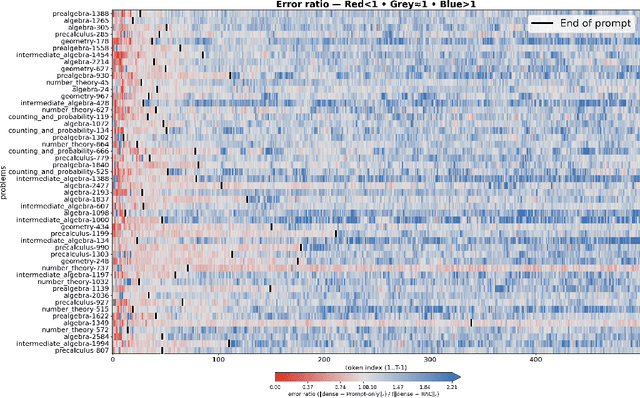
Reasoning language models such as DeepSeek-R1 produce long chain-of-thought traces during inference time which make them costly to deploy at scale. We show that using compression techniques such as neural network pruning produces greater performance loss than in typical language modeling tasks, and in some cases can make the model slower since they cause the model to produce more thinking tokens but with worse performance. We show that this is partly due to the fact that standard LLM pruning methods often focus on input reconstruction, whereas reasoning is a decode-dominated task. We introduce a simple, drop-in fix: during pruning we jointly reconstruct activations from the input and the model's on-policy chain-of-thought traces. This "Reasoning-Aware Compression" (RAC) integrates seamlessly into existing pruning workflows such as SparseGPT, and boosts their performance significantly. Code reproducing the results in the paper can be found at: https://github.com/RyanLucas3/RAC
LiDDA: Data Driven Attribution at LinkedIn
May 14, 2025Data Driven Attribution, which assigns conversion credits to marketing interactions based on causal patterns learned from data, is the foundation of modern marketing intelligence and vital to any marketing businesses and advertising platform. In this paper, we introduce a unified transformer-based attribution approach that can handle member-level data, aggregate-level data, and integration of external macro factors. We detail the large scale implementation of the approach at LinkedIn, showcasing significant impact. We also share learning and insights that are broadly applicable to the marketing and ad tech fields.
On the Robustness of Reward Models for Language Model Alignment
May 12, 2025The Bradley-Terry (BT) model is widely practiced in reward modeling for reinforcement learning with human feedback (RLHF). Despite its effectiveness, reward models (RMs) trained with BT model loss are prone to over-optimization, losing generalizability to unseen input distributions. In this paper, we study the cause of over-optimization in RM training and its downstream effects on the RLHF procedure, accentuating the importance of distributional robustness of RMs in unseen data. First, we show that the excessive dispersion of hidden state norms is the main source of over-optimization. Then, we propose batch-wise sum-to-zero regularization (BSR) to enforce zero-centered reward sum per batch, constraining the rewards with extreme magnitudes. We assess the impact of BSR in improving robustness in RMs through four scenarios of over-optimization, where BSR consistently manifests better robustness. Subsequently, we compare the plain BT model and BSR on RLHF training and empirically show that robust RMs better align the policy to the gold preference model. Finally, we apply BSR to high-quality data and models, which surpasses state-of-the-art RMs in the 8B scale by adding more than 5% in complex preference prediction tasks. By conducting RLOO training with 8B RMs, AlpacaEval 2.0 reduces generation length by 40% while adding a 7% increase in win rate, further highlighting that robustness in RMs induces robustness in RLHF training. We release the code, data, and models: https://github.com/LinkedIn-XFACT/RM-Robustness.